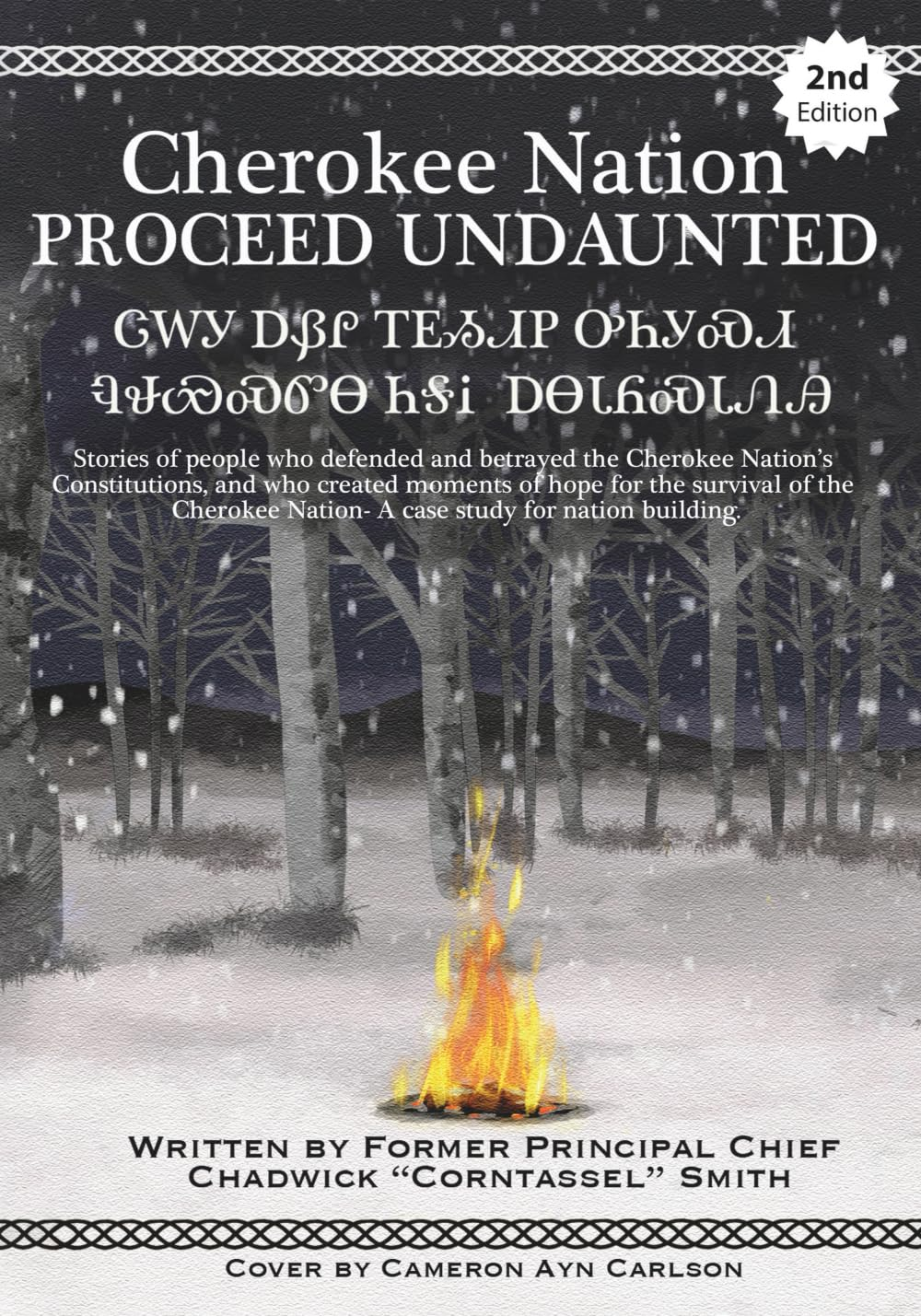
At a time when democratic institutions across the globe face erosion, few stories feel more urgent or inspiring than that of the Cherokee Nation’s internal legal fight to restore its own democracy. InCherokee Nation Proceed Undaunted, former Principal Chief Chadwick “Corntassel” Smith offers a front-line view into one of the most consequential legal struggles in modern tribal governance. He shared the effort to rebuild the constitutional order and defend sovereignty from within.
Smith’s account is a case study in civic resilience.
The Cherokee Nation’s 1999 Constitution was meant to usher in a new era. Built to replace a weakened and externally influenced framework, it reaffirmed self-determination and sought to empower a judicially sound, ethically transparent tribal government. But a decade and half after its ratification, Smith and his fellow reformers witnessed just how vulnerable even the strongest laws can be when ambition overrides accountability.
Defining moments came in the next decade after 2013 when, administration and council legalized nepotism allowing elected officials to hire family members (2014), awarded former Chief Bill John Baker a $400,000 ghost job at Cherokee Nation Businesses (2019), councilmembers doubled their own salaries from $63,000 to $121,000 and the Principal Chief from $180,000 to $365,000/year plus benefits (2023), and the Council granted 42 former councilmembers $40,000 lump sum, 20% tax add-on, $3,000 death benefit, and $500 medical stipend (2024).
Without widespread understanding of the Constitution among citizens, unlawful actions often proceeded unchecked.
Yet the story doesn’t end in collapse. It turns slowly but decisively toward justice.
What makes Proceed Undaunted compelling is not just the list of wrongs, but the roadmap to making them right. Citizens and reformers rallied. Lawsuits were filed. Public discourse returned to fundamental questions: What does the Cherokee Constitution protect? Who is responsible for upholding it? And what happens when leaders defy it?
The result? A gradual but powerful return to constitutional order. The Cherokee Nation’s democracy recalibrated. Through strategic legal action and community mobilization, power was restored to the institutions meant to safeguard the people.
The lessons here are as relevant to Washington as they are to Tahlequah. Not only are strong democracies created, but they are also protected, frequently by law-abiding citizens. Smith’s emphasis on the value of constitutional knowledge, checks and balances, and legal framework serves as a reminder that tribal sovereignty is more than just a concept; it is a way of life.
In reading Cherokee Nation Proceed Undaunted, one walks away with a clear message: the law only matters if we demand that it be followed. For the Cherokee Nation, that demand must come from within. And because of that, their democracy still stands.
Order your copy on Amazon : https://www.amazon.com/dp/B0FN47D586/